My intention is to register here miscellaneous comments without an elaboration and/or without creating an opinion page for each of them (at least at the current time). The page was started in May 2006, but most of the short texts re-iterate opinions that I have expressed decades ago...
I believe the foregoing short text was posted in 2006. Current practices (of TOC PCs) are in clear violation of this opinion and have reached the level of total absurd, disrupting both the quality of the evaluation and the process of running a PC. [Feb 2020]
.... very little do we have and inclose which we can call our own in the deep sense of the word. We all have to accept and learn, either from our predecessors or from our contemporaries. Even the greatest genius would not have achieved much if he had wished to extract everything from inside himself. But there are many good people, who do not understand this, and spend half their lives wondering in darkness with their dreams of originality. I have known artists who were proud of not having followed any teacher and of owing everything only to their own genius. Such fools!
See further discussion in my article on our duties as scientists.
It is unclear why it became legitimate not to answer emails, whereas it is considered impolite not to answer phone messages etc. My theory is that it has to do with the media (i.e., the fact that it is never evident that the message was rec'ed, which is actually a good reason to insist that email be always answered). This does not mean that one has to stop whatever one is doing in order to cope with an incoming email; just answering that the email was received but requires some consideration that cannot be undertaken momentarily is perfectly OK. It is also nice to add an estimate as to when one can expect an answer (or before when one should not expect an answer...). Anything of that type is way better than not answering.
In general, in my opinion, it is perfectly legitimate for any of us to hold his/her priorities and to attend to requests accordingly. What is not legitimate, in my opinion, is not to answer requests.
The celebrated essay On proofs and Progress in Mathematics (by William Thurston) starts by rejecting the vulgar view by which Mathematics is about proving theorems, and explains that Mathematics is about advancing the *understanding* of mathematics (where the circular nature of this definition is intentional). It then explores what understanding means, emphasizing the social dimensions that carry the entire project, and drawing conclusion from this observation. There are nice sections about the problem of communicating ideas and about the different roles of formalism and intuitions. I wish to highlight Section 5, which deals with the sociology of the Mathematics community and the relation between its "point scorers" and the rest. [Nov 2010]
When we state conjectures like P is different from NP, some ask at what input length do asymptotically hard problems become hard in practice. While this question is of paramount importance to practice, it is rather secondary from a theoretical point of view. That is, when dealing with fundamental issues, the primary question is what is the typical (or regular) behavior, whereas the question of when do the irregularities disappear is really secondary.
Originally, the idea of an art (or science) festival seems nice. The idea is to collect and stage a large number of works so as to attract the attention of the wider community and/or to facilitate enjoying as many of these works as possible. (The TCS conferences are indeed a typical example; see my comments on STOC/FOCS.) Things get of the track when the framework of the festival starts to dominate the individual works, when people care more about the festival than of the individual works, and when the festival is perceived as more important than the works presented in it. At this point the festival stops serving the works, and the works start serving it. And at this point the festival is to be abandoned, and has to be replaced by a new framework that serves the individual works. [July 2011]
These three issues are briefly mentioned in the first part of Max Weber's famous lecture/essay Science as a Vocation (1918/19). Since Weber's opinions on these issues are, in my opinion, right on the point, let me present them next.
In contrast to the common practice, the primary role of citations is to be informative (i.e., provide the reader with useful information), whereas fulfilling the scholarly duty is only a secondary concern. This means that if you want to refer the reader to a result (or definition) that appears in some text T, then (unless the text is short or the said result is easy to find in it) you should provide more specific information than [T]. For example, [Thm X, T] or [Sec X, T] or [P. X, T] would make the life of the reader much easiler.
Yes, errors should not exist, but they do. Let me quote my father, Isidor Goldreich (1906--1995), who was a civil engineer: There is no 100% guarantee in the world; whoever wants 100% guarantee should not build anything. So if you discovered an error in your (published) work, just fix it (in public). And if you discovered an error in the work of others, just let them know. And let us hope that there will be less errors in the future. [May 2012]
Errors often emerge whenever one handwaves the details rather than actually work them out rigorously. I have a quote of my father on this too: Wherever the engineer neglects to pay attention, nature pays attention and cracks. So indeed, phrases like ``it is easy to see that X'' are a good place to double-check when going over an argument.
Another suspect phenomenon is a detailed argument that lacks an overview that refers to its main underlying ideas. A sound proof is typically modular: It has underlying ideas and a structure that can be presented at different levels of detail. Providing a modular exposition is not merely crucial for the benefits of readers, but is a good debugging tool (which may leads both to the detection of errors and to simplifications). [June 2012]
While some people believe that there is a benefit in listing publications in their CV in reverse chronological order, in my opinion this belief is wrong (i.e., there is no real benefit in doing so). More importantly, this practice has a cost: It makes the life of recommendation letter writers harder, because when they wish to update their letters, they may need to revise all references to the list of publications. I believe that it is fair to require candidates to attempt to reduce the workload of their recommenders, by taking this consideration into account. [Dec 2013]
Talking of order reminds me of our good fortune in belonging to a community in which alphabetic order of co-authors to a publication is the norm. (I find the opposite convention of ordering co-authors according to the importance of their contribution to the work quite ridiculus.) I strongly recommend to all members of our community to adherse to the norm of alphabetic order, and warn of the situation in which one has some publications in which the order is alphabetic and some in which it is not so. [Dec 2013]
Although I believe that exercises do not advance my own understanding, I am willing to take the word of others who claim that exercises do help them to advance their understanding. Still, they must also realize that exercises are merely means towards something else; that is, one should never forget that the aim is understanding. This implies that one should never allow oneself to get entangled and waste time on an exercise; instead, one should invest the time in gaining understanding of the key conceptual and techincal issues. And here too, the details are means towards understanding the issues. [Dec 2013]
I view arguing as being positioned between thinking and acting, but in this case I disapprove of taking a "middle ground"; that is, I see no point in arguing, and suggest that one should choose between thinking and acting. (This view is stated in response to numerous times in which articulated opinions are answered by rhetoric that picks on some details and is intended to avoid candid consideration of the opinion (by undermining it or its presenter).)
When faced with an articulated opinion of interest, one should first listen to it and try to learn from it, rather than jump to criticizing it or arguing with it. Listening and learning do not necessarily mean adopting, but they refer to an attempt to understand the contents of the opinion and the ideas underlying it. Indeed, once this stage is completed (i.e., once one understands the contents of the new ideas), one may want to consider how to incorporate the new ideas into one's world-view, and a confrontation between ideas may arise. The result may vary between a full adoption of the new ideas to their full rejection, but a partial integration that leads to a synthesis of ideas is also likely (when the both sets of ideas have their merits). Each result may be coupled with deeper understanding of the various ideas, and an articulated reaction to the new ideas may also result and be communicated (or even published). Still the process should start with thinking, not with arguing.
The above refers to opinions that are expressed for the purpose of mutual education, but not every expression is aimed at that. Words can be used as a call for action, and in this case they are instrument of action. If one objects to the proposed action, one better act rather than argue (unless the argument is viewed as an action).
[Aug 2013, rev Mar 2016]
Referring to the sets of YES-instances of decision problems as to ``languages'' is rooted in the history of TOC as emerging from the study of Formal (as opposed to natural) Languages. This historical heritage is disfunctional nowadays, since it comes with a mind-frame that is not the one most adequate for TOC. In short, one better refer to sets by the term sets. [Aug 2017]
Here is a quote from Yoku Zama, the curator/producer of elsewhere music.
My label will feature mainly contemporary works, specifically compositional works which has classical music aesthetics at its roots, but it may not have to strictly belong to the area of contemporary classical music. The essential goal for my label is to find and release good music which touches my heart deeply with its lasting value, created by earnest devotion from the artist's pure soul, which I believe I will want to listen to repeatedly for a very long time - just like I love to return to Schubert or Mahler or Monteverdi, or any past classics that move me over the course of many years. This label may also feature some music outside classical aesthetics - as long as it feels real and genuine, or something that seems as if I were hearing it in the wind or from elsewhere, far away from the noise of the real world.The emphasis in boldface is mine. It refers to what I value most in art: being touched by it, feeling its lasting value, and sensing the earnest devotion of the artists to their pure soul. The parallel to science reads: being illuminated by ideas, thinking that they have a lasting value, and sensing the devotion of the scientists to the pursue of truth.
Of course, one should view the greatest achievements only as an inspiring ideal, not as a realistic target, let alone a yardstick for achievements. [Feb 2020]
In contrast to its sociological meaning, in TOC this term (i.e., folklore) typically means some vaguely specified fact that is known to some experts. I wish to highlight two key ingredients regarding this notion: First, that the known fact is not clearly defined (i.e., its definition is lacking when compared to the standard norms of the discipline). Second, that this knowledge is ``shared'' by few people, who typically publicize their claim of knowledge only after others who were excluded from the folklore actually discover it, distill it, study it, and publish it. Needless to say, the practice of excluding some, let alone most, members of the scientific community from the benefit of the ``folklore'' is incompatible with the basic ethos of Science. In particular, one should hope for the elimination of all folklore: Any fact of value should be specified, distilled, worked-out, and published. [March 2020]
In my opinion, the good intentions underlying DEI and other progressive ideas are seriously hampered by superficial and mechanical implementation. Such unclever implementations seem rooted either in a naive belief that it suffices to have good intentions or in a desire to signal good intentions. In contrast, effecting a progressive social change requires careful thinking and refined strategies.
Amna Khalid, a historian at Carleton College in Minnesota, argues that modern D.E.I. is not, as some on the right hold, a triumph of critical theory or postcolonialism but of the corporatization of higher education, in which universities have tried to turn moral and political ideals into a system of formulas and dashboards. `They want a managerial approach to difference,' Khalid said. `They want no friction. But diversity inherently means friction.'Furthermore, DEI tends to neglect the biggest issue, which is the socio-economical gaps in the society (esp., in the US). Here are two quotes from a CHE 8-Nov 2024 essay By Amna Khalid and Jeffrey Aaron Snyder
NYT Magazine, October 16, 2024
... the importance of material conditions and circumstances. Class matters, despite being conspicuously absent from conventional DEI frameworks.
... there are no instant fixes to social and political problems, an attitude that has been encouraged by campus DEI offices’ drive-thru diversity-training version of social justice. A culture that puts a premium on convenience, immediacy, and pat solutions robs people of the tenacity, commitment, and deep engagement that are essential for bringing about social change.[Oct-Nov 2024]
One often distinguishes natural computational problems from ones that are introduced in order to demonstrate some general computational phenomenon. Why the demostration holds regardless if the problem is natiral or not, there is often an added benefit in having a demonstration that is based on a natural problem. But what is a natural problem? My answer, adapted from my former PhD student Noam Livne, is that an appealing criterion for the claim of being natural is that the problem was not invented for the sake of the demonstration, but was rather explicitly considered before per its own merits. In his paper All Natural NPC Problems Have Average-Case Complete Versions, Noam wrote
The extent to which a computational problem is natural, with respect to some result, is proportional to the amount of references to the said problem that are prior to the said result and occur in a different context.[ECCC TR06-122, 2006]
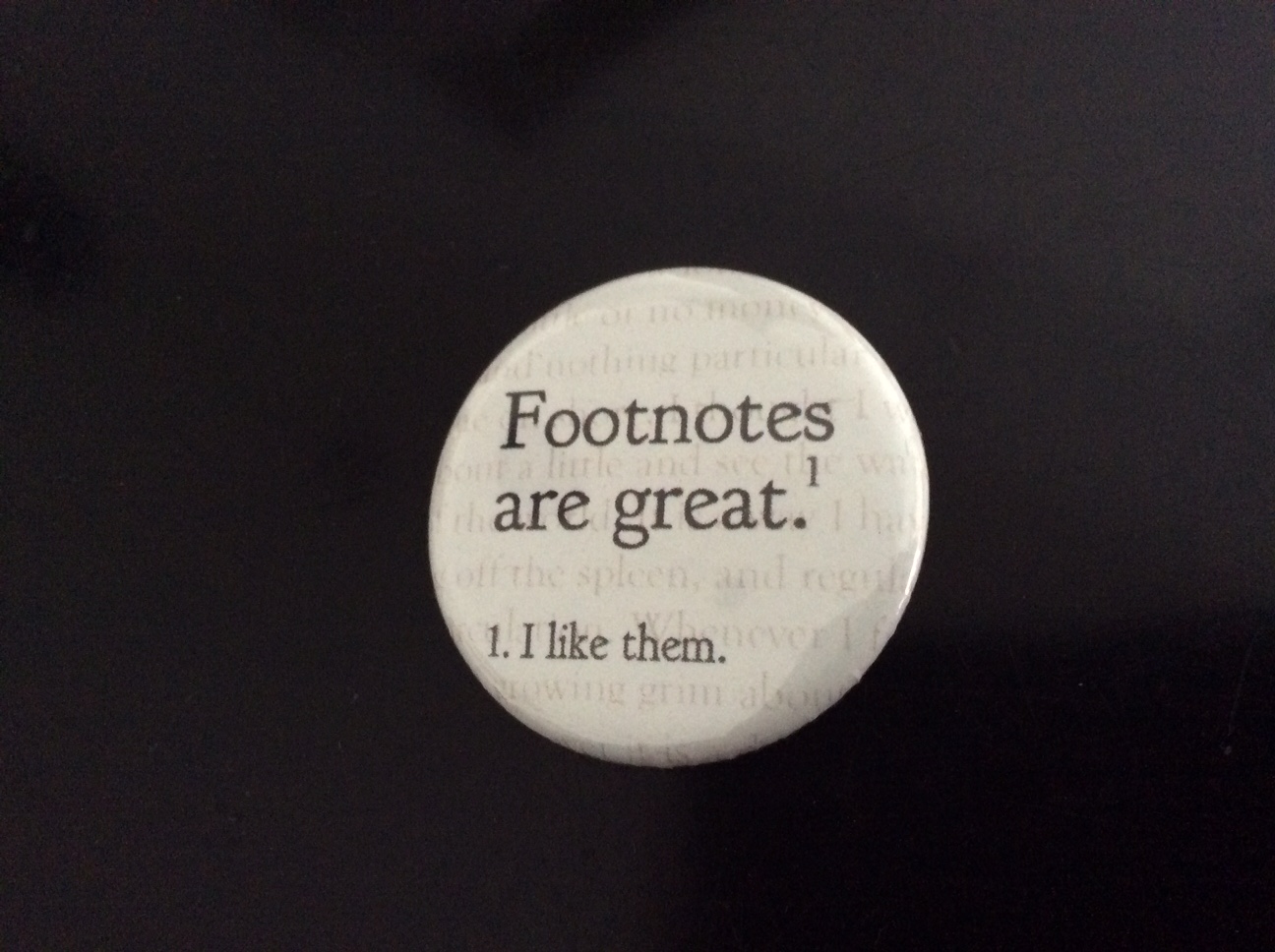
| I tend to use a lot of footnotes. I can justify this practice, which many find imposing, but why not make fun of me instead? |
|
OK. Now for the justifications. I use footnotes to make either side comments or provide techical elaborations that most readers can spare. The point is that both types of additions are useful, but in some cases I feel that they should not interfere with the flow of the main idea to which they relate. So footnotes are compromises between conflicting wishes: the wish to enrich the text and the wish not to interfere with its flow. To readers who claim that footnotes interfere with their reading, I'd answer that other solutions seem worse to me, and that readers should train themselves to handle footnotes. |
Back to the top or to Oded Goldreich's opinions and essays or to Oded Goldreich's homepage.